Letters of Coverage Explained: How to Request and Appeal
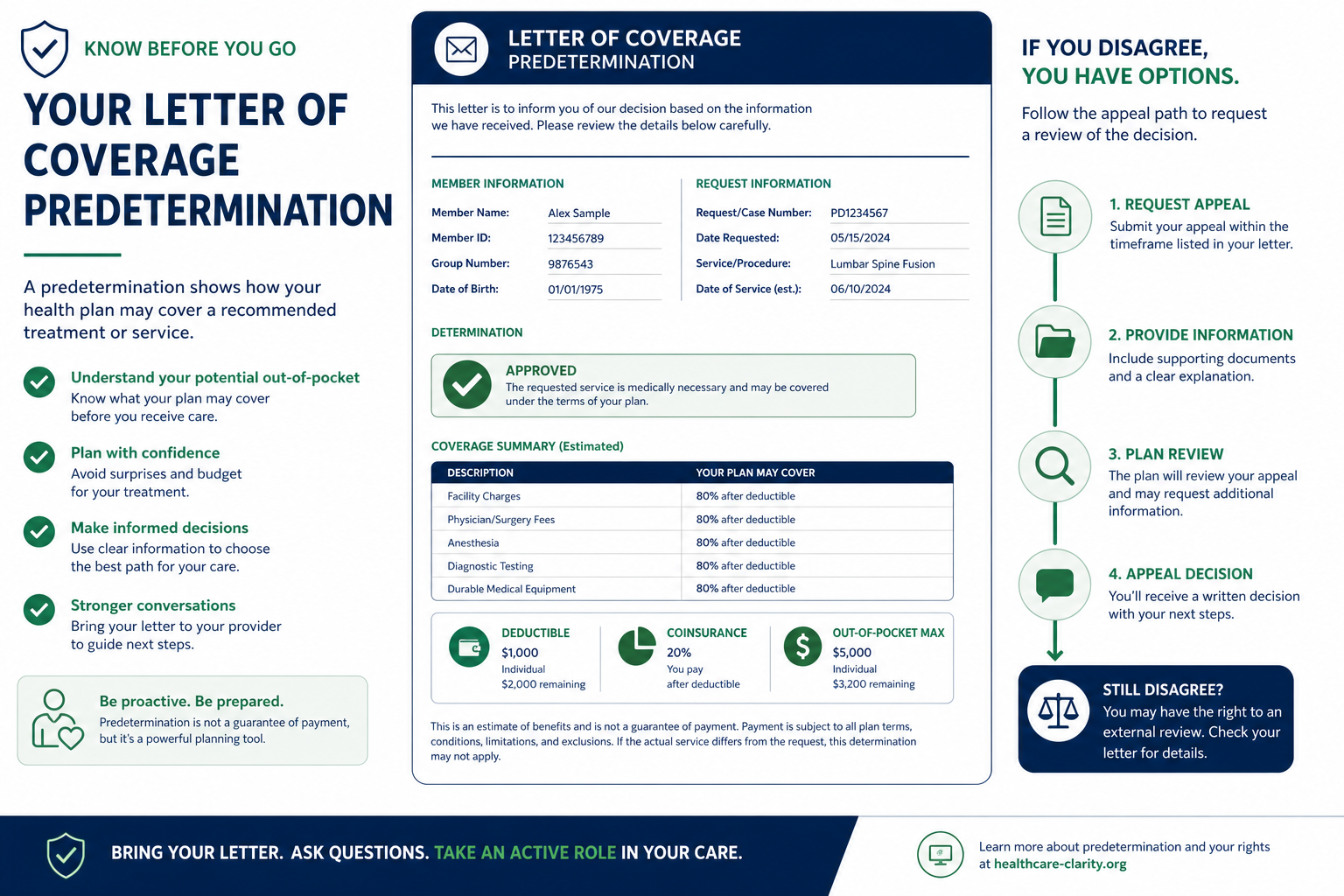
What Is a Letter of Coverage?
Key Takeaway: A letter of coverage is a written benefits confirmation, not a bill and not always a final approval. It documents what your plan says it would cover for a specific service, drug, or procedure based on the codes and clinical info submitted at request time.
Patients call these documents many things: predetermination letters, pre-service determinations, benefits verification letters, or pre-treatment coverage confirmations. Insurers use different labels, but the function is the same. You use the letter to reduce surprise denials by confirming coverage before you schedule surgery, imaging, or start an expensive prescription.
A verbal estimate from member services is not the same thing. Without a written predetermination, you have little to cite if the post-service claim is denied. Request the response in writing and save the reference number.
Do not confuse this with a Medicare Creditable Coverage Letter. That document proves you had prior drug coverage when enrolling in Part D. The letter of coverage discussed here applies to pre-treatment benefit verification on commercial, employer, and many Medicare Advantage plans.
Letter of Coverage vs. Prior Authorization vs. Predetermination
Key Takeaway: Prior authorization is a gate. You need approval before service on many plans. A letter of coverage or predetermination is an estimate that may still require separate prior auth. Know which document your plan issued before you rely on it at the pharmacy or surgical scheduler.
| Document Type | What It Does | Binding? |
|---|---|---|
| Benefits verification (verbal) | Phone estimate of copay or coinsurance | Rarely. No written record. |
| Letter of coverage / predetermination | Written estimate of medical necessity and benefits | Sometimes. Check plan language. |
| Prior authorization approval | Formal approval required before service | Yes, for the approved codes and dates |
| EOB after service | Final claim adjudication result | Yes. This is what was actually paid. |
Some employer plans treat a favorable predetermination as binding if the actual treatment matches the submitted codes and clinical scenario. Others print a disclaimer on every letter stating the response is not a guarantee of payment. Read that disclaimer. It determines whether you have a strong contradiction appeal later. For more on prior auth gates, see our guide on what prior authorization is.
How Do I Request a Letter of Coverage?
Key Takeaway: Submit exact ICD-10, CPT, HCPCS, or NDC codes with your request. Vague descriptions produce vague letters that fail when the real claim uses different codes. Get a written response with a reference number.
- Gather codes from your provider. Ask for the planned diagnosis codes (ICD-10), procedure codes (CPT/HCPCS), drug name and NDC for pharmacy, and the rendering provider's NPI. Without codes, member services can only give a generic estimate.
- Choose the correct submission channel. Medical services: insurer portal or Availity. Pharmacy: CoverMyMeds (prescriber-initiated) or PBM portal. Using the wrong channel delays or loses your request.
- Submit clinical documentation. Attach the physician's treatment plan, prior therapy history, or letter of medical necessity if the plan requires it for predetermination, not just for prior auth.
- Request written confirmation. Ask for email, portal message, or mailed letter. Save the reference number, date, and name of the representative if you called.
- Verify prior auth status separately. Even a favorable letter of coverage may state that prior authorization is still required. Confirm PA approval before scheduling.
- Check expiration dates. Many predeterminations expire in 30 to 90 days. Treatment outside that window may require a new request.
For pharmacy benefits, your prescriber often initiates the request through CoverMyMeds while you track status on Express Scripts, OptumRx, or Caremark. If your doctor's office submitted the original prior auth through Availity, ask them to request predetermination through the same system for consistency.
How to Read a Letter of Coverage
Key Takeaway: Scan for code mismatches, hidden step therapy requirements, and expiration dates before you commit to treatment. The letter is only useful if the final claim uses the same codes and clinical scenario.
When you receive the letter, check these fields line by line:
- Member ID and group number to confirm the letter applies to your active coverage
- Diagnosis codes that must match what your provider will bill
- Procedure, CPT, HCPCS, or NDC codes. A different code on the claim triggers denial.
- Coverage determination: covered, not covered, or medical necessity review required
- Prior authorization status: approved, denied, or still required
- Patient responsibility: copay, coinsurance, deductible application
- Effective and expiration dates. Treatment outside this window may not be covered.
- Conditions and limitations: step therapy, site-of-service rules, in-network requirements
A common edge case: the letter approves an MRI with contrast (CPT 70553) but your radiologist bills without contrast (70551). The insurer denies because the approved code does not match. Share the letter with your provider before the appointment and confirm billing codes align. After service, compare the letter to your Explanation of Benefits line by line.
Weak vs. Strong Predetermination Requests
Key Takeaway: Specific codes and clinical context produce letters you can actually use. Generic requests produce generic answers that fall apart when the real claim is processed.
| Weak Request | Strong Request |
|---|---|
| “Is my knee surgery covered?” | “Predetermination request: CPT 27447 (total knee arthroplasty), ICD-10 M17.11, surgeon NPI 1234567890, facility in-network, prior conservative therapy documented (PT for 12 weeks, NSAIDs for 6 months). Request written coverage determination.” |
| “Member services said my medication is covered when I called.” | “Written predetermination for Wegovy (NDC 00169-4520-12), ICD-10 E66.01, submitted via CoverMyMeds key #ABC123. Reference call #CS-789456 on 2026-07-15. Requesting written confirmation matching verbal estimate.” |
| “I got a letter saying covered but no reference number or codes listed.” | “Letter of coverage #PD-2026-44821 confirms coverage for CPT 72148 (lumbar MRI without contrast), valid 90 days, PA #PA-99102 approved. Attached to surgical scheduling and billing department before scan date.” |
Denied After a Letter of Coverage?
Use AppealFlow's free generator to draft an appeal letter that cites your predetermination, the denial contradiction, and your plan's appeal rights.
Why Letters of Coverage Fail to Protect You
Key Takeaway: A letter of coverage only helps if treatment matches what was submitted. Code changes, out-of-network providers, expired dates, and missing prior auth are the four reasons favorable letters still lead to denials.
- Code mismatch: Provider bills a different CPT, HCPCS, or NDC than the predetermination
- Expired predetermination: Treatment scheduled after the letter's validity window
- Prior auth gap: Letter says medically necessary if PA approved but PA was never filed or was denied
- Network change: Provider or facility moved out-of-network between letter date and service
- Plan amendment: Employer changed formulary or benefits mid-year at renewal
- Non-binding disclaimer: Plan language explicitly states predetermination is not a guarantee
Self-pay patients sometimes request a letter of coverage to estimate costs before treatment. That estimate can still change if the billed codes differ from what was quoted. Always confirm codes with the billing department, not just clinical staff.
How Do I Submit a Request Through My Insurer or PBM Portal?
Key Takeaway: Use the portal tied to your actual PBM or insurer, not a generic fax. Portal submissions create trackable reference numbers that strengthen contradiction appeals later.
| Platform | Used For | LOC / Predetermination |
|---|---|---|
| Availity | BCBS, Aetna, Humana, many regional plans | Eligibility & Benefits, then Predetermination or Pre-Service Review |
| CoverMyMeds | Pharmacy PA and benefits across multiple PBMs | Prescriber-initiated; patient tracks status via key code |
| Express Scripts | Cigna, some BCBS pharmacy benefits | Member portal, Pharmacy, Coverage Check or PA Status |
| OptumRx | UnitedHealthcare, employer plans | OptumRx.com, Prior Authorization, Benefits Verification |
| Caremark (CVS) | Aetna, CVS Health plans | Caremark.com, Coverage & Claims, Check Drug Coverage |
After portal submission, download or print the confirmation page. If the portal only shows status without a downloadable letter, call member services and request a mailed or emailed copy citing your submission reference number.
How to Appeal When Your Letter of Coverage Was Ignored
Key Takeaway: File an internal appeal citing the predetermination letter, reference number, and specific contradiction between pre-service determination and post-claim denial. When your plan treats predeterminations as binding and the facts match, contradiction appeals are often stronger than generic medical necessity disputes.
- Compare letter to EOB line by line. Note every mismatch: codes, dates, network status, medical necessity determination.
- Request your complete claim file. Under ERISA Section 503, participants in ERISA-covered employer plans can review documents the insurer used to deny the claim. Request this in writing.
- Write a formal appeal letter. State that the post-service denial contradicts predetermination reference number and date, which confirmed coverage for the listed codes.
- Attach the letter of coverage, EOB, and clinical records. Incomplete packets are a common reason contradiction appeals fail.
- Submit through the appeals channel, not the PA resubmission form. After denial, you invoke appeal rights. See our guide on how to file an insurance appeal.
- Request external review if denied again. ACA individual and small-group plans have external review rights after an internal denial. ERISA employer plans follow a different path. Read our overview of how to request external review.
What Deadlines Apply to Predeterminations and Appeals?
Key Takeaway: Predetermination turnaround and appeal clocks vary by plan type. Read the deadline printed on your denial notice and your Summary Plan Description. Do not assume ERISA, ACA, and Medicare use the same calendar.
- Predetermination request: Many plans respond in about two to four weeks for standard requests. Urgent requests may move faster when your physician certifies that delay poses a health risk.
- Internal appeal: ERISA plans must decide within specified timeframes after receiving a complete appeal. ACA marketplace plans follow separate internal review rules under 45 CFR Part 147. Your denial letter states the clock that applies to you.
- External review: For ACA plans, external review generally follows the timeline in your state's program or the federal HHS-administered process. See CMS appeals and grievances guidance for plan-type distinctions.
Common myth: A verbal benefits quote from member services is the same as a letter of coverage. Insurers routinely deny contradiction appeals when patients have no written predetermination, only a call log. Always get it in writing.
Five Mistakes That Waste Your Letter of Coverage
Key Takeaway: Requesting a letter but not sharing it with your billing department, or assuming it replaces prior authorization, is how favorable predeterminations turn into surprise denials anyway.
- Not forwarding the letter to your provider's billing team. Clinical staff may schedule treatment without confirming codes match the predetermination.
- Relying on verbal confirmation only. Call logs rarely win contradiction appeals.
- Missing the prior auth step. A letter saying covered if medically necessary and PA approved is not approval. See how to appeal a prior authorization denial if PA was denied.
- Letting the letter expire. Calendar the expiration date the day you receive it.
- Resubmitting PA instead of filing a formal appeal. After post-service denial, invoke appeal rights. Do not just resend the CoverMyMeds request.
Frequently Asked Questions
Answers to common questions about letters of coverage, predetermination, and pre-treatment benefit appeals.
Generate Your Free Appeal Letter
AppealFlow drafts a formal appeal letter citing your letter of coverage, predetermination contradictions, and plan appeal rights. Edit live, then download as PDF or Word. No account required.
- 100% Free
- No Signup
- PDF & Word Export
Disclaimer: This article is for educational purposes only and does not constitute medical or legal advice. AppealFlow is not a healthcare provider or law firm. Always review appeal letters with your prescriber before submission. For medical emergencies, call 911. See our full disclaimer.