PET Scan Prior Authorization Denied: What to Do
Why Was Your PET Scan Prior Auth Denied?
Key Takeaway: PET denials usually fall into five categories: medical necessity, NCCN criteria not met, missing prior authorization, conservative imaging not attempted first, or experimental classification. Your denial code and Explanation of Benefits tell you which clinical argument to build.
Insurers rarely deny PET technology itself. They deny when the clinical record does not match their imaging policy or when required steps were skipped. Read the denial letter alongside your Explanation of Benefits and note the reason code, CPT code, and any radiology benefit manager named on the notice.
Common denial patterns for PET scan prior authorization:
- Medical necessity not established: The plan argues CT or MRI already provides sufficient staging information for your clinical scenario.
- NCCN criteria not met: Your cancer type or stage does not match the plan's interpretation of NCCN Clinical Practice Guidelines for PET at this point in workup.
- Prior authorization not obtained: The scan was scheduled before auth was approved. This is often a procedural denial rather than a clinical one.
- Conservative imaging not attempted: The plan requires CT first and wants documentation of CT limitations before approving PET.
- Experimental or investigational: PET for certain cancer types or restaging intervals the plan considers outside standard of care.
What Documents Do You Need for a PET Scan Appeal?
Key Takeaway: A complete PET appeal packet usually includes your denial letter, oncology letter of medical necessity, pathology or biopsy results, prior imaging, NCCN guideline citation, and a treatment impact statement. Missing pathology is a common gap on first submissions for staging appeals.
Use this checklist before you draft your PET scan medical necessity appeal. Number each enclosure in your letter so the reviewer can match attachments to your argument.
- Denial letter and Explanation of Benefits with reason code and appeal instructions
- Oncologist letter citing cancer type, stage if known, ICD-10 code, and specific NCCN recommendation for PET at this clinical point
- Pathology or biopsy report with date when tissue confirmation is part of the staging workup
- Prior CT or MRI reports showing limitations that PET would address
- Statement of how PET results will change treatment decisions, such as surgery versus chemoradiation
- Printed NCCN guideline excerpt for your cancer type when your physician agrees it applies
For broader medical necessity language, see our how to write a medical necessity letter. PET appeals need oncology-specific staging detail on top of that structure.
How Do You Appeal a Denied PET Scan Authorization?
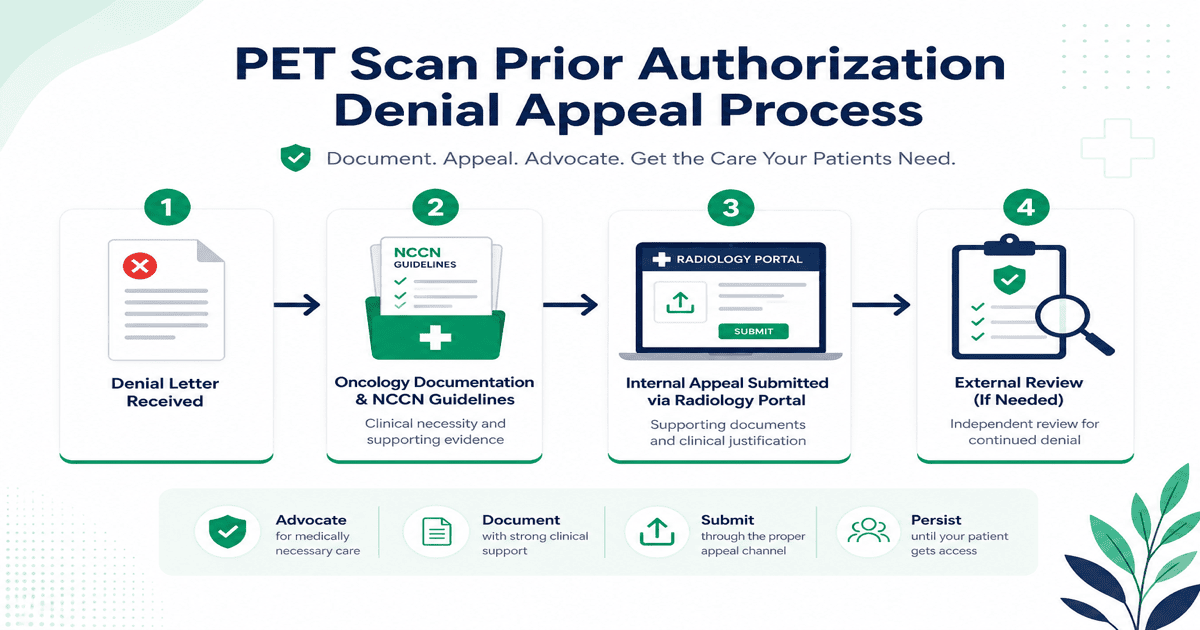
Key Takeaway: File your internal appeal before the deadline on your notice, attach a complete oncology packet, and request expedited review when treatment planning depends on staging results. Mark the appeal deadline the day you receive the denial.
- Confirm your appeal deadline. ERISA employer plans often allow up to 180 days for an internal appeal under ERISA claims and appeals procedures. ACA marketplace plans follow the clocks on your notice under Healthcare.gov appeal rules. Medicare uses separate redetermination timelines on Medicare.gov.
- Request the insurer's clinical criteria. You need the policy section cited in the denial so your letter addresses each PET requirement point by point.
- Get an oncology letter of medical necessity. It must cite NCCN guidelines for your cancer type and explain how PET results will change treatment decisions.
- Attach pathology and prior imaging. Biopsy results, CT reports showing limitations, and tumor markers strengthen staging appeals.
- Draft your member appeal letter. Include member ID, authorization reference number, CPT code, ordering physician NPI, and a numbered enclosure list. For format guidance, see how to write an insurance appeal letter.
- Request expedited review when clinically appropriate. When delay would seriously jeopardize health, your physician can request urgent processing under ACA expedited appeal rules. See our guide on how to request an expedited insurance appeal.
- Submit through the correct radiology portal. Availity, eviCore, RadMD, or the channel listed on your denial. Confirm receipt before your deadline.
- If denied again, request external review when eligible. Qualifying ACA and many state-regulated plans must offer independent review after internal appeals are exhausted. See how to request external review after an insurance denial.
You can start from a tailored draft using AppealFlow's MRI and imaging denial appeal generator, then have your oncologist review the clinical facts before submission.
Weak vs Strong PET Appeal Wording
Key Takeaway: Oncology medical directors approve PET appeals when the letter explains how staging results will change treatment. A scan order alone is not medical necessity. Changed treatment decisions are.
| Weak wording | Strong wording |
|---|---|
| “My oncologist ordered a PET scan for cancer staging. Please approve.” | “FDG-PET/CT staging per NCCN Guidelines for Non-Small Cell Lung Cancer, Category 2A. Biopsy-confirmed adenocarcinoma attached. PET required to distinguish Stage IIIA from IIIB, which directly determines surgical candidacy versus chemoradiation.” |
| “CT scan was not good enough. We need a better scan.” | “Contrast CT chest and abdomen shows a 3.2 cm RUL mass with indeterminate mediastinal lymphadenopathy. PET required per NCCN to characterize nodal FDG avidity and exclude distant metastases before treatment planning.” |
| “This is medically necessary. FDA approves PET scans for cancer.” | “Authorization reference #PA-48291, denial dated 7/15/2026 for CPT 78815. I request internal appeal under my plan documents. Attached: oncology letter of medical necessity, pathology report, CT report, and NCCN guideline excerpt for NSCLC staging workup.” |
Need a PET Scan Appeal Letter Drafted?
AppealFlow's imaging appeal generator drafts a medical necessity letter structured around your denial reason, oncology staging rationale, and insurer appeal rights.
How Do You Cite NCCN Guidelines in a PET Appeal?
Key Takeaway: Generic references to NCCN guidelines are usually insufficient. Cite the specific cancer type, guideline version, recommendation category, and clinical scenario that supports PET at this point in workup.
NCCN guidelines are widely used by insurer medical directors evaluating oncology imaging appeals. Your prescriber should cite the exact recommendation for your cancer type. Common examples patients see in PET appeals:
- NSCLC: NCCN Guidelines recommend FDG-PET/CT for Stage I through III staging when curative treatment is planned
- Hodgkin lymphoma: PET/CT at initial staging and interim restaging per NCCN Category 1 recommendation
- Colorectal cancer: PET generally not recommended for routine staging, but may be indicated when CT suggests potentially resectable metastatic disease
- Melanoma: PET/CT for Stage III through IV staging when standard imaging is equivocal
Include a printed excerpt from the relevant NCCN guideline page as an attachment. For restaging PET scans, the letter must explain why restaging is clinically indicated, such as disease progression on imaging, new symptoms, or evaluation after treatment completion per NCCN follow-up guidelines.
Where Do You Submit a PET Scan Prior Auth Appeal?
Key Takeaway: PET prior auth appeals route through radiology benefit managers or insurer portals listed on the denial, not pharmacy benefit managers. Submitting to the wrong system delays appeals.
| Platform | Used by | Appeal submission |
|---|---|---|
| Availity | Aetna, many BCBS plans, Humana | Provider or member portal, authorizations section, appeal with clinical attachments |
| eviCore | UnitedHealthcare, Anthem, some regional plans | eviCore healthcare portal, imaging section, prior auth appeal with fax backup |
| RadMD | Multiple national carriers for radiology benefits | RadMD provider portal, appeal submission with NCCN documentation |
| Carelon | Anthem, some BCBS affiliates | Carelon portal, advanced imaging appeals with oncology letter attached |
Your denial letter lists the correct portal and fax number. If your oncologist's office initiated the original prior auth, ask them to file the appeal through the same system. For prior authorization disputes generally, see how to appeal a prior authorization denial.
How Long Does a PET Scan Appeal Take?
Key Takeaway: Standard internal appeals often take about 30 days after complete documentation is received. Expedited oncology appeals may require a decision within 72 hours when your physician certifies that delay would seriously jeopardize health. External review follows separate clocks on your notice.
For cancer staging, request expedited review when treatment planning is on hold. Your oncologist must certify that delay would seriously jeopardize your health or ability to regain maximum function under your plan's urgent appeal rules.
Timing tip: Paying out of pocket and seeking retroactive authorization after the scan is difficult for many oncology imaging policies. File the appeal before the scan when possible, or ask your facility about self-pay rates and financial assistance while you wait.
What Mistakes Delay PET Scan Appeal Decisions?
Key Takeaway: PET appeals fail when the oncology letter does not explain treatment impact. Generic NCCN references, missing pathology, missed deadlines, and wrong submission portals cause most avoidable delays.
- Generic oncology letters without specific NCCN citations for your cancer type and staging scenario
- Missing pathology or biopsy results when tissue confirmation is part of the staging workup
- Not requesting expedited review when cancer staging delays treatment planning
- Submitting to the wrong portal when a radiology benefit manager issued the denial
- Not requesting external review after an upheld internal denial when your plan type qualifies under ACA or state law
Frequently Asked Questions
Common questions about PET scan prior authorization denials, NCCN criteria, deadlines, and submission channels.
Generate Your PET Scan Appeal Letter
AppealFlow drafts a medical necessity appeal letter for denied PET, MRI, and CT scans. Enter your denial details, edit the letter live, and export PDF or Word. No account required.
- 100% Free
- No Signup
- PDF & Word Export
Disclaimer: This article is for educational purposes only and does not constitute medical or legal advice. AppealFlow.net is not a healthcare provider or law firm. Appeal deadlines and imaging criteria vary by plan type and state. Verify requirements on your denial letter and plan documents before filing. For medical emergencies, call 911. See our full disclaimer.