What to Do If Insurance Denies Medication
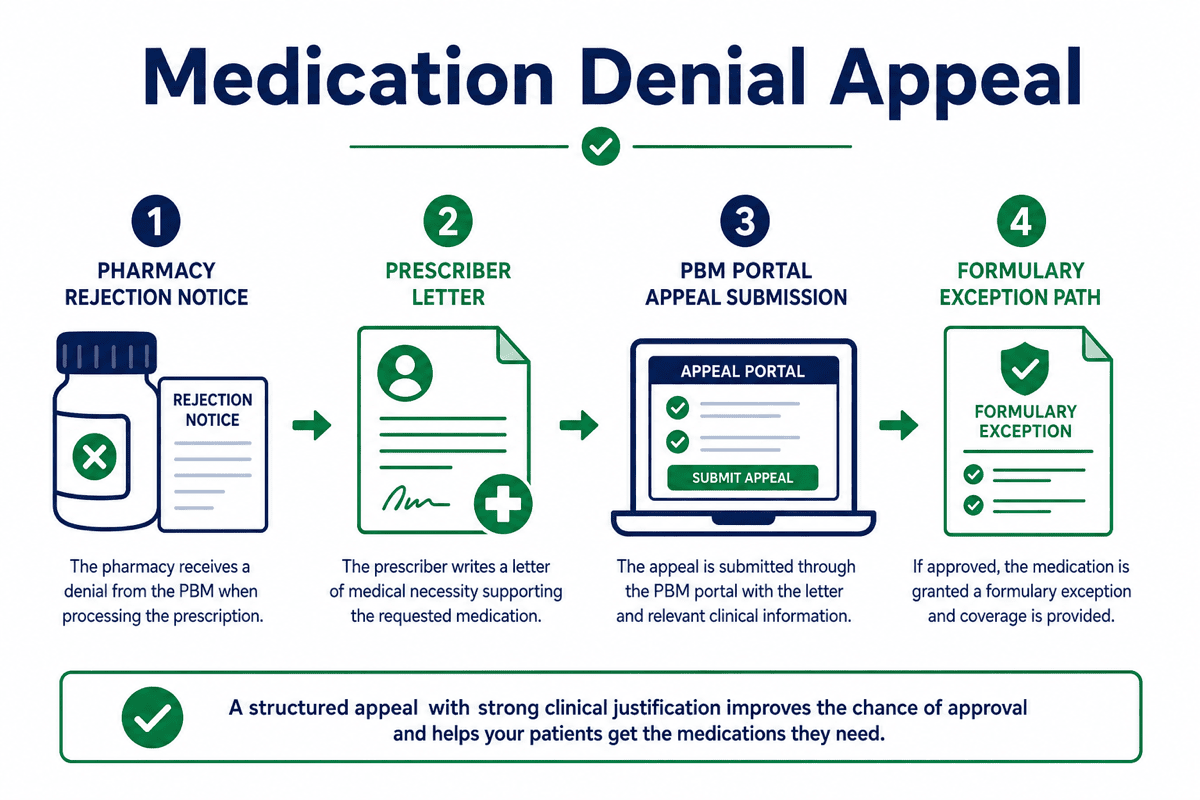
What Should You Do in the First 24 Hours?
Key Takeaway: Treat a pharmacy denial like a time-sensitive notice: pull the denial letter, identify the reason code, calendar your appeal deadline, and call your prescriber before the clinic closes for the day.
If you searched for what to do if insurance denies medication, you may be at the pharmacy counter or reading a text alert that your refill was rejected. The first day matters because appeal deadlines are fixed and your prescriber may need several business days to assemble clinical records. For the past-tense workflow after a denial is already on file, see what to do when insurance denied medication.
- Get the denial in writing. Ask the pharmacy for the rejection message or call member services on your insurance card. You need the reason code, not only a generic “not covered” screen.
- Confirm whether paying cash affects appeal rights. Some plans will not retroactively approve a prior authorization after you purchase the drug without authorization. File the appeal first unless your prescriber confirms a one-time emergency fill is available.
- Call your prescriber's office. Leave the drug name, strength, quantity, denial code, and member ID. Ask for a supporting statement tailored to that code.
- Identify your pharmacy benefit manager. Check your insurance card for Express Scripts, OptumRx, Caremark, or another PBM name. Pharmacy appeals usually route through the PBM, not the medical claims department.
- Calendar your appeal deadline. ERISA employer plans often allow up to 180 days. ACA marketplace plans commonly use 60 days. Medicare Part D redetermination is generally 60 days from the notice. Use the date on your letter.
What Type of Pharmacy Denial Do You Have?
Key Takeaway: Your denial reason code determines your strategy. A step therapy denial needs failed-alternative documentation. A formulary exclusion needs a formulary exception. A missing prior auth needs a complete PA packet, not the same fix for every rejection.
Pharmacy denials look interchangeable at the counter, but insurers classify them into distinct buckets. Match your appeal to the bucket listed on your notice or your appeal may fail on procedural grounds alone.
| Denial type | What it means | Primary action |
|---|---|---|
| Prior auth not obtained or expired | No active approval on file for this drug | Complete PA submission with clinical packet via PBM portal. See our prior authorization appeal guide |
| Step therapy not met | Plan requires cheaper drugs first | Documented trials with dates, doses, outcomes, or contraindications. See how to appeal a step therapy denial |
| Not on formulary | Drug excluded from covered list | Formulary exception with failed alternative records. See formulary exception denied: what to do next |
| Quantity limit exceeded | Fill exceeds plan's allowed days' supply | Prescriber attestation of medical need for higher quantity or dose |
| Diagnosis code mismatch | ICD-10 code does not match plan criteria | Corrected claim with proper diagnosis from prescriber |
Read the denial letter twice. Insurers sometimes list a secondary reason. Your appeal must address every listed reason, not only the first one.
How Does the PBM Pharmacy Appeal Process Work?
Key Takeaway: A formal pharmacy appeal is a written request invoking your plan's appeal rights. It is not a repeat of the original prior auth form. Include your member ID, denial reference number, prescriber NPI, and new clinical evidence addressing the specific denial code.
Most commercial drug benefits run through a pharmacy benefit manager with tiered formularies and prior authorization rules. After an adverse benefit determination, you generally have the right to an internal appeal under ERISA for employer plans or ACA Section 2719 for many marketplace plans.
- Request your claim file. Ask for every document the plan used to deny you. Missing information in that file is often something you can supply on appeal.
- Obtain a prescriber supporting statement. The letter must cite the denial reason, list failed alternatives with dates when applicable, include diagnosis codes, and explain why covered alternatives are inadequate or contraindicated.
- Gather supporting records. Visit notes, lab results, medication history printouts, prior auth correspondence, and the denial letter itself. Label each attachment.
- Write your appeal letter. State that you are formally appealing the pharmacy coverage determination, cite your appeal rights, and summarize the clinical evidence. Reference the denial code by name.
- Submit through the correct PBM channel. Upload to Express Scripts, OptumRx, or Caremark member portals, or have your prescriber submit through CoverMyMeds using the key code on the denial. Confirm receipt and save a reference number.
- Request expedited review if medically urgent. If delay poses serious health risk, your prescriber can certify urgency. ACA plans must decide many expedited appeals within 72 hours.
How Do You File a Formulary Exception Appeal?
Key Takeaway: A formulary exclusion triggers a different appeal type than a prior authorization denial. You must show that covered alternatives are ineffective, contraindicated, or cause intolerable side effects, with dated trial records for each alternative the plan lists.
Formulary exception requests ask the plan to cover a non-formulary drug or to place a restricted drug on a lower cost-sharing tier. Medicare Part D plans must consider a physician supporting statement per Medicare.gov Part D appeals guidance. Commercial plans follow PBM exception policies printed in your evidence of coverage.
Your prescriber should document each formulary alternative individually:
- Drug name and tier on your plan's formulary
- Whether a trial was attempted, refused due to contraindication, or clinically inappropriate
- Specific medical reason the alternative fails, such as efficacy, allergy, drug interaction, or organ dysfunction
- Supporting specialist opinion when the case is complex
For brand-name drugs when generics fail, see our brand-name drug appeal guide.
What Documents Do You Need for a Prescription Appeal?
Key Takeaway: Incomplete packets are the most common reason pharmacy appeals stall. Use a checklist and label every attachment so reviewers can match your arguments to the evidence.
| Document | Why it matters |
|---|---|
| Denial letter with reason codes | Sets the appeal deadline and tells you which arguments to address |
| Prescriber supporting statement | Clinical rationale tied to the specific denial type |
| Visit notes and lab results | Backs diagnosis, severity, and prior treatment response |
| Pharmacy fill history | Proves prior trials and dates for step therapy or formulary exceptions |
| Prior auth correspondence | Shows what the plan already reviewed and what was missing |
Weak vs. Strong Pharmacy Appeal Language
Key Takeaway: Pharmacy reviewers approve appeals backed by dated clinical facts. Replace vague statements with ICD-10 codes, drug names, doses, trial dates, and plan criteria references.
| Weak statement | Strong statement |
|---|---|
| “My doctor prescribed this medication and I need it. Please approve.” | “I formally appeal denial reference [number] for [drug name]. Patient diagnosis [ICD-10] with documented step therapy failure on [drug] from [date] to [date] per attached visit note dated [date].” |
| “I tried other medications and they didn't work.” | “Documented trials: [drug A] [dose] from [date] to [date], discontinued for [reason] per note dated [date]; [drug B] [dose] from [date] to [date] with inadequate response. Requested drug meets FDA indication for [diagnosis] per attached clinical summary.” |
| “This drug is FDA approved so insurance should cover it.” | “I request a formulary exception for [drug name] because plan-preferred alternatives [drug A, drug B] are contraindicated due to [condition] per attached specialist note. Covered alternatives failed or are medically inappropriate, not merely less convenient.” |
Need a Draft Prescription Appeal Letter?
AppealFlow builds pharmacy appeal language from your denial reason and clinical facts. Edit live, then download PDF or Word.
Submitting Through PBM Portals: Express Scripts, OptumRx, Caremark, CoverMyMeds
Key Takeaway: Most commercial plans route pharmacy appeals through a PBM portal. Submitting through the wrong channel is a common reason medication appeals get lost or rejected as incomplete.
Check the back of your insurance card for your PBM name, then use the matching portal. If your prescriber originally submitted the prior auth through CoverMyMeds, the appeal should usually go through the same system using the key code on your denial notice.
| Platform | Used by | How to file an appeal |
|---|---|---|
| CoverMyMeds | Multiple PBMs; prescriber-initiated PA | Prescriber submits via key code; patient can attach appeal documents |
| Express Scripts | Cigna, some BCBS plans | Member portal, pharmacy appeals section; fax backup to number on denial letter |
| OptumRx | UnitedHealthcare, some employer plans | OptumRx.com prior authorization and appeals workflow |
| Caremark (CVS) | Aetna, CVS Health plans | Caremark.com coverage and claims appeals section |
After uploading, call the PBM to confirm receipt. Portal submissions sometimes fail when file sizes exceed limits or required fields are blank. Ask for a confirmation number and the expected decision date.
What If You Need Medication While the Appeal Is Pending?
Key Takeaway: Plans are generally not required to provide medication during a standard appeal. Ask about manufacturer assistance, therapeutic alternatives, or an expedited appeal if delay would seriously harm your health.
Running out of a maintenance drug creates real health risk. In those cases, request an expedited appeal and ask your prescriber to certify that delay poses serious harm.
- Manufacturer patient assistance programs: Many brand-name drug makers offer free or reduced-cost medication while appeals are pending.
- Copay savings cards: These reduce out-of-pocket cost but do not replace insurance coverage. Read the terms carefully.
- Therapeutic alternatives on formulary: Ask your prescriber whether a covered equivalent can bridge the gap safely.
- Sample supply from prescriber: Some offices keep samples for urgent situations.
Important: Paying full retail price and appealing for retroactive reimbursement rarely works for pharmacy claims. Many PBMs will not retroactively approve a prior auth after you purchase the drug without authorization.
What Happens After an Internal Pharmacy Appeal Is Denied?
Key Takeaway: An upheld internal denial is not always the end of the process. Many ACA plans offer independent external review for eligible medical judgments. Medicare Part D escalates to IRE review per your Medicare notice.
Read the upheld denial for instructions on the next level. Healthcare.gov's external-review page explains independent review after an upheld internal appeal for many marketplace plans. Medicare Part D uses redetermination and IRE steps described on Medicare.gov.
For appeal deadline context across plan types, see how long you have to appeal a health insurance denial.
Frequently Asked Questions
Pharmacy denials, PBM appeals, formulary exceptions, and escalation after an upheld denial.
Generate Your Prescription Denial Appeal Letter
AppealFlow drafts pharmacy appeal letters for prior auth denials, step therapy blocks, and formulary exceptions from your denial reason and prescriber facts. Pair the draft with your physician's supporting statement for a complete PBM packet.
- 100% Free
- No Signup
- PDF & Word Export
Disclaimer: This article is for educational purposes only and does not constitute medical or legal advice. AppealFlow is not a healthcare provider or law firm. Always review appeal letters with your prescriber before submission. For medical emergencies, call 911. See our full disclaimer.